Decline or Fall
The penguin at the end of empire

When in the nineteen-eighties Jerry Falwell and the Moral Majority turbocharged the reactionary backlash to the social progress of the sixties and seventies, they lamented the decline of American virtue by condemning the rival devotions of liberalism and spearheading the renewal of “traditional” religion, setting the stage for the revanchist Christian nationalism that currently reigns supreme. The language here chimes with what one finds in Saint Augustine’s discussion of the decline and fall of Rome in the City of God, though, curiously enough, less with how the Bishop of Hippo describes the decadence of the last imperial days and more with the pagan accusations from which he spends some time defending Christianity. The decay, says Augustine, had burrowed deep in the Roman heart long before the advent of the new religion, and the imputed causal relationship between the rise of the Jesus cult and the collapse of “traditional” society was really only a case of illumination by contrast. “What kind of gods were these,” Augustine asks, “who declined to live with a people who worshipped them, and whose corrupt life they had done nothing to reform?”
The second Trump administration has ushered in such a various and complex constellation of shitstorms and scandals both at home and abroad it is really no wonder that many have declared this moment the death knell for the age of American supremacy. The most notable of these, of course, was Canadian Mark Carney’s pronouncement at Davos that “we are in the midst of a rupture, not a transition.” Without making direct reference to his southern neighbor, referring instead to the array of assumptions and gentlemen’s agreements that undergirded the neoliberal international order and its replacement by “great power rivalry,” Carney made it clear that the corruption of the American state and its subsequent unpredictability means not simply a shifting of global influence, but the terminal failure of globalization as it has been practiced since the end of the Second World War.
It’s a deceptively simple observation. Of course it reiterates how uniquely powerful the United States has been for the entire postwar period, notwithstanding its Cold War rivalries, a fact that has become so natural we have until recently ceased to notice it, making the frequent propagandistic reference to foreign “threats” seem even more absurd than they do at face value. But Carney’s description of the now-crumbling status quo also revealed the distinctiveness of that order, which, in addition to being the age of American imperialism, was also the managed decline of other empires. The dispersal of European colonial holdings and the reorganization of the relationships between resultant states being underwritten by a global hegemon with its thumb forever on the scales (to put it mildly) is a form of having it both ways, post-imperially: it is an admission that the old forms of domination are no longer feasible but a refusal to accept the full diminution of power that embracing such a paradigm shift might otherwise entail.
What Carney described as the protection of “middle powers” by international organizations like the WTO, IMF, and so on, could equally be understood as the generosity offered by American imperial power to its chosen representatives. Belgian prime minister Bart de Wever admitted as much when he said last week that “being a happy vassal is one thing, being a miserable slave is something else.” Needless to say, and no one any longer even tries to pretend otherwise, the generosity afforded to the vassal states was not extended on the same terms to former colonial nations trying to establish the conditions of their own sovereignty for the first time. But neither was it extended to postwar America’s last great rival, Russia, when it finally ceased to pose a real challenge to global dominance. Instead of the assisted transition to social democracy that Gorbachev had wanted and asked for, Russia instead received Boris Yeltsin and shock therapy, which in just a few years brought national poverty rates up from 2-3% to nearly 50% and life expectancy down nearly five years, leading to a constitutional crisis, the violent suppression of massive street protests and the firebombing of the White House, Moscow’s main government building where legislators had barricaded themselves inside in protest of Yeltsin’s dissolution of the congress.
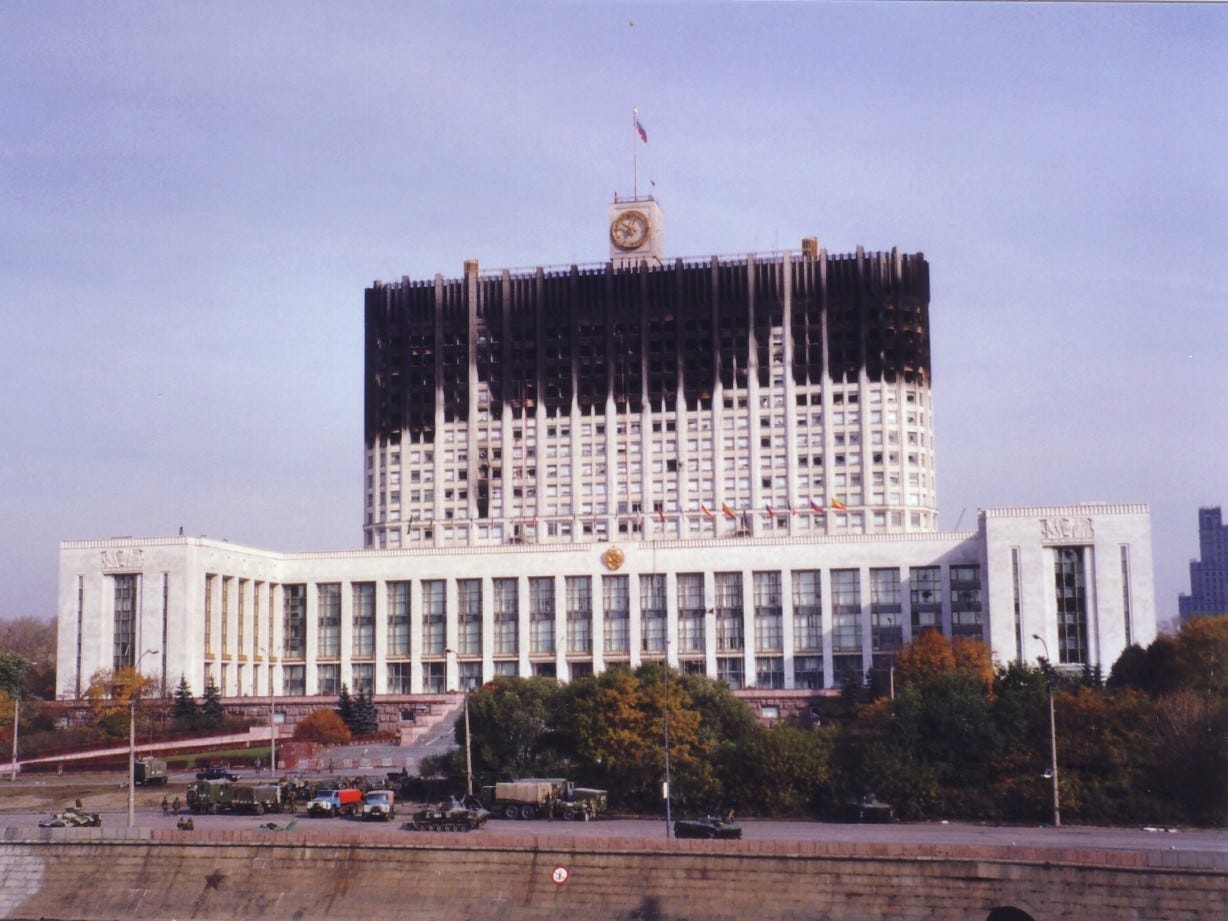
Of course, the collapse of the American empire will not directly reproduce any of these precedents; just as our empire functioned differently than any previous, so too will our fall be distinctive, if not unique. All things remaining equal, there might be some element of managed decline of the European states will be folded into the stripped-for-parts fire sale of the post-Soviet experience. We are, after all, still fabulously wealthy, and a globally integrated economy is not something that can be dismantled overnight, however much Donald Trump wishes it could be. Meanwhile, our institutions are proving stronger than many expected them to be, and, as we’ve seen in Minnesota, Americans in general are far more willing to stand up for themselves than the clichés would have us believe. But even if we escape our present gangster-autocrats and transition, by some miracle, to a more just and equitable distribution of wealth and power, the world seems ready to move on. Our best hope is in finally unburdening ourselves of our exceptionalism, our hubristic rage for superiority, and help to build a truly cooperative international order.
The dreadful alternative is that we allow ourselves to be pitched into more pointless conflicts with allies and rivals alike, which are matched in their vicious arbitrariness only by an increasingly repressive apparatus at home. This is, of course, the present state of things, and while the resistance against ICE in Minnesota has been truly inspiring, the failure of the Democrats to mount an effective challenge to the regime is a reminder that our system has become far more conducive to the elimination of our rights than to their protection.
For a decade now, there has been endless discussion, speculation, argument, polemic about what it is in American life, in the American soul, that led us to this disaster. I don’t mean this as a dismissal: it’s an endless, or near-endless, subject, and the proliferation of etiologies, from the original sin of slavery to the vulnerability to fascism in liberal democratic proceduralism, has, in addition to providing political analysis, has led to a far greater historical self-understanding in this country than anything I had witnessed in my life prior.
But the endlessness of the subject takes on its own quality, and raises its own kinds of questions, which push on beyond the historical and the political, or at least more deeply into what defines those realms, in the collective imagination, the popular faith, the devotions that define us. What gods, to echo Augustine, have we been praying to?
As ever, images help guide the way to understanding. Just recently, we were treated to a new image in government propaganda which I think will be the subject of discussion for some time to come. On Friday, the official X account of the Department of Homeland Security posted a single sentence and an accompanying video. The sentence reads: “Americans have always known why.” The video is a clip from the Werner Herzog 2007 documentary, Encounters at the End of the World, in which an Antarctic penguin, for reasons unknown to anyone, turns away from his colony and feeding grounds and waddles out into the frozen wasteland toward mountains some 70 km away, in other words, to certain death. It’s a tough watch, especially for a softie like me, but it’s also morbidly fascinating. In a voiceover, Herzog tells us that even if the penguin were to be caught and brought back, he would immediately turn around and head out toward the mountains again. “But why?” he asks. The video then cuts into the faux-inspiring montage of armored trucks rolling through city streets, bald eagles atop border fences, and other such heralds of American psychopathy, to the soundtrack of an organ rendition of the popular dance song “L’amour toujours,” recently appropriated by the German far right.

The most charitable reading of this bizarre sequence is as a paean to American individualism, its willingness to go it alone, and so on. In a moment of mounting international skepticism of, not to say resistance to American might, this self-valorization would make a certain amount of cynical sense. But why, then, is it being promulgated by a domestic agency to defend its assault on American cities? And why choose a clip that, in the full version, is specifically referred to as an example of avian confusion, disorientation, and insanity? Is it related to the White House’s concurrent preoccupation with the semi-aquatic sea birds, which in turn is an apparent reference to Greenland, where there are no penguins?
The obvious answer here is that American exceptionalism has reached its suicidal nadir. The proponents of this new turn would rather depart from the rational, indeed, from the realm of the living, than concede that there is a world beyond their will, which is their god. And when a god possesses you like that, driving you away from others and toward your own destruction, it is better described as a demon. This is what collapse looks like, socially, politically, spiritually. The question is not whether the decline can be reversed, but only if we as a society can be exorcized in time for our fall not to devour us whole.
Brilliant. The penguin video was unknown to me, but its use in this context is indeed a perfect example of the psychosis of our rulers.