Descartes' Priest
Stray thoughts on a footnote from the encyclical

Going back over Magnifica Humanitas in preparation for a podcast appearance I was about to make—stay tuned, by the way—I found myself picking through the footnotes, not really reading for content, but just seeing what names came up. This is a part of academic scholarship I always enjoyed, and it’s the first thing I tend to think of when I hear the AI faithful sing joyfully of what drudgery their product will relieve us of: the ostensibly mindless spadework that keeps us from doing real thinking, whatever that might be. But I learned a long time ago that those moments of semi-diligence, doing what one has to do without any real intensity or even much focus, are often necessary to create the space for creative connections, clarifying insights, or even simply noticing things that rest just below the surface, holding the work together less by argumentative force than by associative suggestion. It’s those gossamer strands of thought that make a text more than just another contribution to the big file folder in the sky; they reveal a written work as an act of deep intention, an offering given up for readers both known and unanticipated, a creation to be encountered, not consumed.
Deep in the encyclical, at footnote 210, one such strand emerges:
P. de Bérulle, Discours de l’état et des grandeurs de Jésus, Discours IV, Unité de Dieu en l’incarnation: Œuvres complètes, Paris 1856, col. 218.
The name, Bérulle, jumped out at me for purely personal reasons. Ten years ago, while working on my Master’s at the University of Chicago, I took a course on Descartes with Jean-Luc Marion, the French philosopher and theologian. To my young mind, Marion represented a kind of academic and university life that was then passing away, really was already quasi-mythical, and now seems like it hardly ever existed at all. He a was serious historian of philosophy who also made radical contributions as a philosopher in his own right, which in turn were as much theological as philosophical. Back then, “interdisciplinary” was high praise, but in retrospect I think part of what I found attractive about these disciplinary transgressions was that they assumed the existence and significance of disciplinary boundaries to begin with; if there was a certain amount of intellectual freedom gained by the loss of that assumption, there was also something lost when all the questions it raised evaporated with it.
Marion made no apologies for representing the old order, even as some of his work contributed, at least by function of reputation, to its erosion. He was constantly clad in tweed (a little red stitch in the left lapel indicated that he was a chevalier of the French Legion of Honor); he smoked a pipe; he was a little too dismissive of students whose work did not immediately interest him. But his erudition and insight were beyond reproach, and he spoke about great philosophers and theologians as though he knew them personally. Of course, some of them he did know personally—he had a famous debate with Jacques Derrida, and as a student had taken part in an informal discussion group with Jean Daniélou and Henri de Lubac—but his familiarity extended deep into the past, and names like “Spinoza” and “Arnauld” were spoken as though they referred to someone whose office we might visit after class, if we proved ourselves worthy.
One such name was Cardinal Pierre de Bérulle. Bérulle (1575-1629) was a major figure in the French Counter-Reformation, known now primarily as the founder of the French school of spirituality, which puts enormous emphasis on the Incarnation, that is, that God really did become human in the person of Jesus Christ. This focus produced a galaxy of new and renewed questions about how we as human beings ought to relate to the world and to God, which Bérulle pursues through a somewhat paradoxically pessimistic, Augustinian lens. Put very crudely: By noticing that the human life of Jesus was not an especially glorified one, indeed, was one marked by humiliation, exile, abasement, and agonizing death, we find the truth of what sin has made of our life on earth. And by embracing that degradation, we create the space for the love of the God who made himself nothing for our sake. But lest this self-negation seem hopelessly gloomy, reflection on God’s embodiment is in Bérulle an almost cheerful affair, creating a metaphysical perspective that infused every human activity with divine possibility.
In fact, according to Descartes’ first major biographer, Baillet, it was Bérulle who first encouraged Descartes to withdraw from public debate and pursue the philosophical foundations of the then-new natural sciences, leading to the epochal Meditations, the formulation of the cogito, and much of the conceptual structure of the modern world. (This was the context in which Marion brought the cardinal up, albeit in order to argue that this story was probably apocryphal, and that Descartes’ positions actually contradict Bérulle’s, but there’s no time to get into that now.) Later members of Bérulle’s order, the Congregation of the Oratory of Jesus and Mary Immaculate, were also early enthusiasts of the French Revolution, especially its ideals of liberty and equality, though this support was not exactly mutual; the order was disbanded in 1792, and members who refused secularization either fled the country or were arrested. When the Oratory was reestablished in the nineteenth century, it flourished in ways Bérulle would have approved, as a free community devoted to science, education, and the adoration of the Eucharist as the real presence of God.
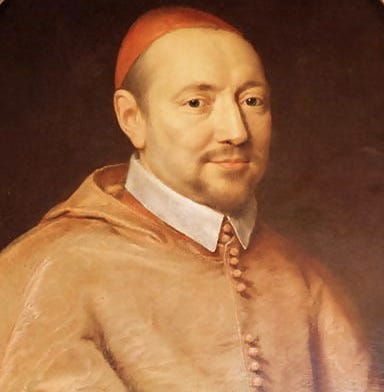
So, what is Bérulle doing in Magnifica Humanitas? There are obvious resonances with the encyclical’s attempt to bridge scientific and moral questions, but it is in the text’s critical, almost polemical aspects that Bérulle comes most in handy. Here’s the full paragraph in which the citation appears:
232. In the promises of transhumanism and some posthumanist currents of thought, which seek an enhanced and almost disembodied humanity, we recognize a yearning that is of concern to us, namely the need for a fuller life, less exposed to limitations and suffering. Yet the Incarnation opens a different pathway. On the one hand, old and new ideologies alike urge humanity to overcome limitations through technology, and to rise above others by asserting dominance. Contrary to this, the mystery of the Son of God entering into our human condition promises something quite different. The living God descends into our history in order to free us from all forms of slavery. [209] He takes upon himself our weakness and transforms it into a setting for salvation. There is no moment or human situation that is not worthy of God. “According to the teaching of our faith, we have and adore, in our mysteries, a God who is born in a manger, a God who lives and travels in Judea, a God who dies on the cross, a dead God who lies in the tomb.” [210] The future of humanity, therefore, finds its standard in the ability to welcome this divine way of drawing near, of sharing the burden of the world, of transforming relationships from within. “O wonder... man is God and this God-Man passes through all those stages, endures all those states and ennobles them, sanctifies them, deifies them in himself!” [211] What saves humanity is the divine love that descends into the most fragile point of our history and renews it from within.
One of the pleasures of this encyclical is in its crystalline simplicity. The message here is clear: the scientific dogma of our time encourages us to overcome limitations in order to dominate over nature and over others. Christ, by contrast, teaches us to embrace our limitations, to see vulnerability and fragility as gifts that provide us with the opportunity to care for one another, and to lift one another up by sharing and attempting to alleviate each other’s burdens.
It’s an attractive alternative, and I think it’s enough to be persuaded against techno-fascism by this simple appeal to the necessity of human care. But I want to point—and only briefly—to a critical element underlying it that shows the subtlety of Leo’s argumentation. In short, if the technoscientific modernity that made Silicon Valley possible begins in the seventeenth century Scientific Revolution, and especially with the metaphysical arguments laid out by Descartes, what Leo shows by quoting Bérulle is that not only do authoritarian technologists not understand human life, they don’t even understand the history of their own project. Descartes’ famous ambition for science, that it allow us to become the “lords and masters of nature” has long been interpreted as providing the philosophical foundation for the rapacious and extractive, for cruel and triumphant domination. But what if, the encyclical leads us to ask, somewhere in his mind, he was also thinking of the role of lord as Bérulle might have thought of it, that is, as someone who sacrifices himself unto death for the sake of those he loves?
I think it’s this kind of reflection that, apart from its crucial intervention into the urgent moral issues of our time, makes MH such a compelling text. It has a lot to do with Leo’s being, like Bérulle, a follower of St Augustine. At a crucial moment in his Confessions, Saint Augustine finds himself stripped of all worldly attachment, desperate to see God, and writes: “Mihi quaestio factus sum,” I have become a question to myself. It is, in certain ways, the foundational posture of Christianity; the radical opening-up of oneself to the possibility of renewal, which is necessarily the basic questionability of everything one thought one knew. The world itself, in the Christian vision, is fundamentally available to revision, even complete transformation. But while the early Jesus followers took this apocalyptic vision to heart, casting aside daily concerns and orienting themselves entirely toward the anticipated second-coming, already by the fourth and fifth centuries, when Augustine was writing and acting as Bishop of Hippo in North Africa, the Church had come to see its mission as more dispersed, treating the Parousia less as a distinct event in historical time, never mind one that was just around the corner, and more as a guiding principle, an ardent hope, and an article of faith at once less immediately pressing and more consistently formative. For a Church that was embarking on a millennia-long project of institutionalization, including long centuries as a self-consciously worldly, temporal, political power, Augustine’s radical self-questioning was, as much as anything else, a way for the bishop to ensure a place within that institution for the uncertainty, the instability, the power of the paradoxical proposition, indeed, the impossible experience, that God became a human being, and asked us to reciprocate.
Love the recollection of Marion embedded herein. An exemplar, indeed.