Use Your Words!
A brief reflection on an ongoing crisis

Thanks in part to a recent New Yorker essay on the subject, my performativity piece from two months ago has been given a new shot of life, netting me quite a few new subscribers (welcome!) and a chance to reconsider the subject. I’m still more or less pleased with how it turned out and with the response that it got, as well as evermore dismayed that the word continues to be abused in this way (though I knew that wasn’t going to change.) As I tried to stress in the piece, I do think the refashioning of “performative” into a term of derision is a real loss, as well as a form of unconscious complicity with truly sinister actors in our culture, and not simply a matter of evolving definitions or ordinary degradation of meaning. The attempt to clarify this is not about linguistic prescriptivism or telling people what to do, but of tracking changes in our shared self-understanding, the words we choose and the social forces conditioning those choices.
Whenever I start talking like this, I know I risk eye-rolls and exasperation. Aren’t there more important things to be thinking about? Of course there are! But it’s precisely because these are questions of secondary importance that they must be asked and attended to carefully and critically. My little essay was an attempt at a style of thinking that has one of its homes in the broad tradition of the Marxist critique of everyday life, which tries to demystify the apparently unchanging and irreproachable facts of our ordinary experience to illuminate the commerce between the supposed individual consciousness and the supposedly unconscious social world. The goal of this critique is not simply to lay bare previously ignored assumptions, but to shake loose the calcification around facts to reveal that they are actually decisions, ones which we have not consented to and might want to make differently. Paying attention to inconspicuous emotional and affective associations, like the fun people have saying the word ‘performative,’ is an important part of this, since it’s evidence not only of a neutral linguistic process of linking a sign with a signified, but the attempted satisfaction or, more likely, denial of an unspoken desire. To put it bluntly, ‘performative’ has become a sneer at precisely the moment when we have all more or less recognized that we are not free in the ways we thought we were.
And there are other words that mark this recognition. “Critique” to mean criticize or attack, rather than evaluate dispassionately the limits and possibilities of something, comes to mind. One astute reader asked me about the recent usage of the word “aesthetic” to mean some combination of cool, attractive, and distinctive, rather than simply a descriptive term of how things relate to our sense experience. This is indeed similar to “performative,” and to “critique,” which are all neutral, technical terms that entered into the wider lexicon by lopping off exactly half of their evaluative capacity. I would include “aura” and “impact,” in this list, too.
These are all words that used to be the condition of an evaluation, setting up a terrain for the speaker to then assert their own opinion and judgement, and are now stand-ins for the evaluation itself. By that I mean, there is less of a chance of a thorough or illuminating critique when it is assumed that the object of critique will be harmed. We become less able to determine a false or misleading aura when it is always praiseworthy to have one at all. Every thought leader has an impact, and so did the meteor that wiped out the dinosaurs. What, exactly, do we say about the aesthetics of something when it has been decided in advance that it is simply aesthetic? (This one comes with the sad assumption that to act upon us aesthetically has become remarkable, since most things are ugly and hostile to human pleasure, but that’s another essay.) I’m sure you could think of ten more words for which it used to possible to be good or bad, and now simply is. Those are all sites where we were once invited to think, and where it is now harder, if only a little, to do so.
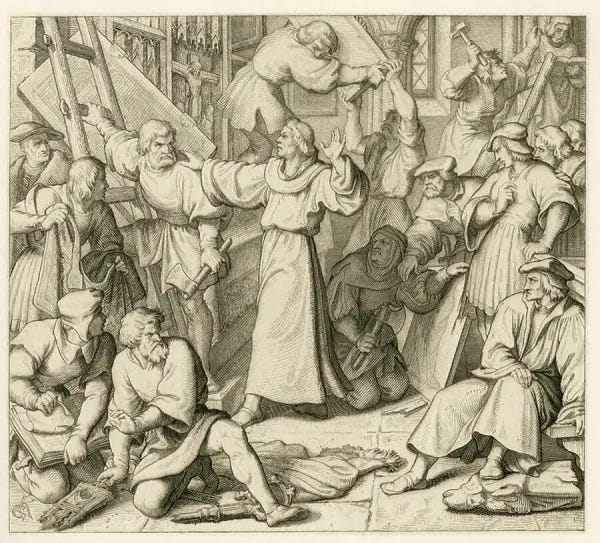
The critique of everyday life is an attempt to reopen a place for thought where it has been foreclosed. Historically, the primary target of this critique has been religion. Marx himself called this the prerequisite of all other critique, arguing that at its root religion is the system of false identifications that make repression at once easier to bear and harder to see. This is where we get his famous phrase, “opium of the people,” which is far less derogatory than most assume it to be. Here it is in full, from A Contribution to the Critique of Hegel’s Philosophy of Right:
Religious suffering is, at one and the same time, the expression of real suffering and a protest against real suffering. Religion is the sigh of the oppressed creature, the heart of a heartless world, and the soul of soulless conditions. It is the opium of the people.
The abolition of religion as the illusory happiness of the people is the demand for their real happiness. To call on them to give up their illusions about their condition is to call on them to give up a condition that requires illusions. The criticism of religion is, therefore, in embryo, the criticism of that vale of tears of which religion is the halo.
Criticism has plucked the imaginary flowers on the chain not in order that man shall continue to bear that chain without fantasy or consolation, but so that he shall throw off the chain and pluck the living flower.
This is beautiful, profoundly humane writing, which takes seriously religion as a human practice, even as Marx seems aware that the first reaction it will prompt will be defensiveness and opprobrium. That is the risk of all criticism. But Marx is clear that his task is not mere idol-smashing, but the cultivation of a new space where we can encounter the fullness of our own possibility, which, so far from being merely compensatory for the past pleasures and comforts, will make them seem hollow and false by comparison, if we even remember them. The struggle he asks us to take up, and that all criticism asks us to take up, is to pass through the austerity of the unadorned chain, a Golgotha of our own mind, on the way to a remade world.
I probably don’t have to point out what a profoundly religious impulse this is, and how much more complicated the situation is that simply a question of casting off illusions in favor of reality. “The foundation of irreligious criticism is: Man makes religion, religion does not make man,” Marx writes. As an attack on fideism and fundamentalism this is obvious and irrefutable, but what of the subtler, more thoughtful, richer religious sensibility that is already aware of the historical contingency of its practice, and sees that not as a sad, inescapable fact, but as the foundation of its truth? That is to say, what of the religious community that takes its own rituals and beliefs as ongoing negotiations with certain realities that constantly demand reflection and even revision? What if religion is not a testament to a final revelation, but a site of contestation about what we say and what we mean by it and what we are required to do?
The other day, Pope Leo gave a Jubilee audience in Saint Peter’s Square. He spoke beautifully about religious practice and political participation, urging the faithful to seek God, but to “seek Him with intelligence, with the heart, and with our sleeves rolled up!” It’s a useful counterclaim to the boastful bullshit bandied about by certain Catholics in our country and abroad, who seem to think of their faith as triumphant and complete, a sign of superiority—even of election—that gives them the power to do as they see fit. It’s necessary to defeat this mentality, and it’s encouraging to have the Holy Father on our side of the battle.
I do, however, have one small bone to pick with Il Papa. In the course of his remarks, he also said the following: “Do I use my talents for good? Do I look toward the coming of the Kingdom of God when I carry out some service? Or do I grumble, complain that everything is going wrong? ‘The smile on our lips is the sign of grace within us.’” Well, with all due deference, I reserve the right to scowl, and to grumble, and to complain that everything is going wrong. These too are acts of faith.